
At a glance
- Angleton's Sec. 23-60 names live oak a heritage tree, but homestead owners are excepted from the rule.
- In Florida hurricane studies, live oak ranked in the highest wind-resistance group, and pruned trees survived better than unpruned ones.
- Hypoxylon canker doesn't affect healthy, vigorous oaks, but it can quickly colonize stressed ones.
- Don't cut roots closer to the trunk than five times its diameter.
Why does Angleton protect the live oak?
Angleton's Land Development Code names two heritage trees in Sec. 23-60: "Live oak - Quercus virginiana;" and "Pecan - Carya illinoinensis." On plats and site plans for new development, the developer totals the caliper inches of heritage trees to be removed and multiplies by three to set the mitigation, and an engineer's 2024 letter on one project notes the city "will accept no less than three (3) caliper-inches of trees (Live Oak or Pecan)" as replacements (checked Nov 14, 2026).
None of that reaches a family's own yard. The same section excepts "The owner of any residence used as a homestead." The protection matters mostly when land is being subdivided or developed. Live oak is also on Lake Jackson's approved tree and shrub list.
How did live oaks hold up in the hurricane studies?
The University of Florida's "Wind and Trees: Lessons Learned from Hurricanes" sorted trees by how they came through Florida's hurricanes. Live oak, sand live oak and southern magnolia made the highest group. Pecan, water oak, laurel oak and Chinese tallow landed in the lowest (Florida data; checked Nov 14, 2026).
The same paper found things that apply to any oak:
- Trees in groups of five or more survived better than trees standing alone.
- After Hurricane Georges in Puerto Rico, survival rose with rooting space, from 64% with 0 to 3 square meters to 91% with more than 7.
- Trees in shallow soils are more likely to blow over; good soil depth, a deep water table and uncompacted soil help a tree resist wind.
- Pruned trees survived better than unpruned ones, 73% against 47%.
That's useful context in a county where Beryl's gusts reached 85 mph at the Brazoria County Airport and 97 mph near SH-36 at the Brazos River in July 2024 (National Weather Service, checked Nov 14, 2026). A strong species still needs room for its roots and a crown without dead wood.
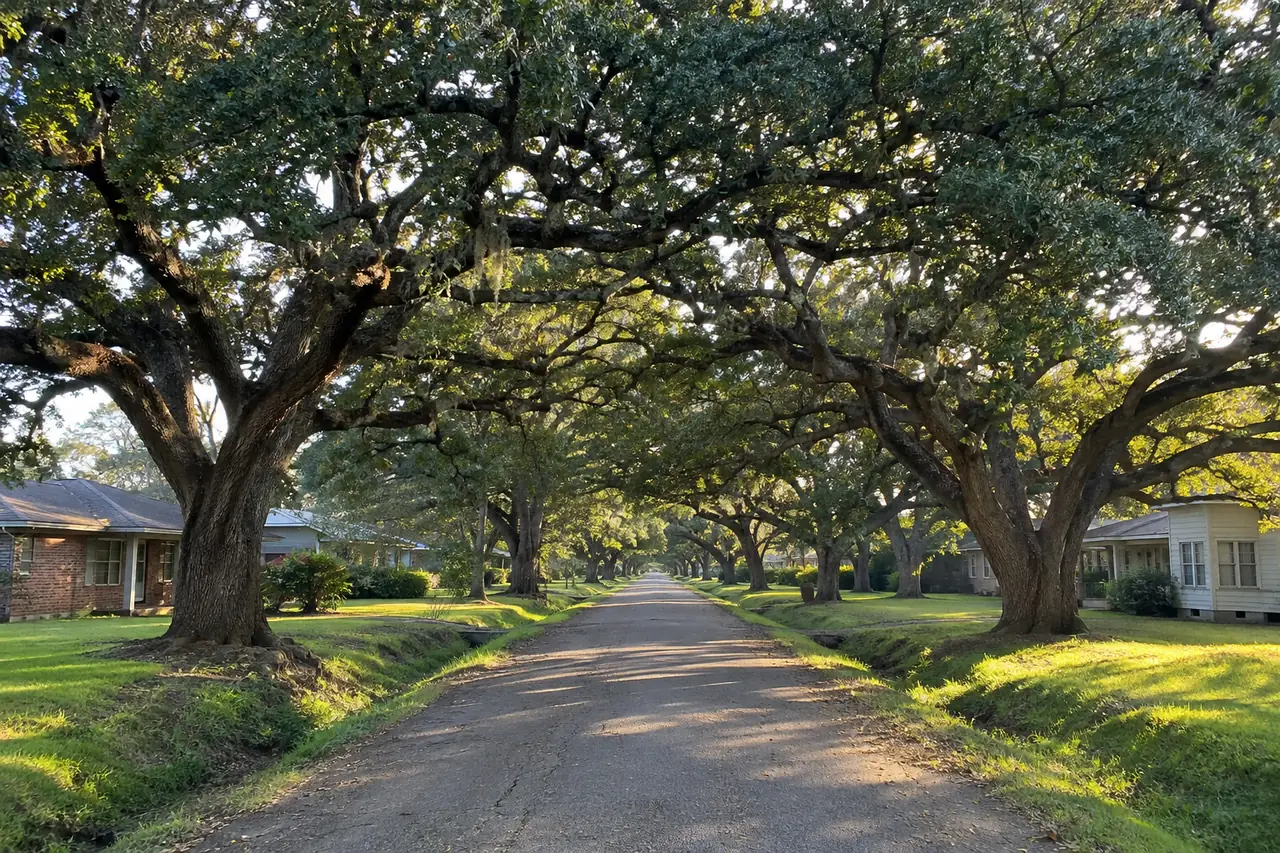
Pruning a live oak: what to take, what to leave
Start with the county's list. Brazoria County's disaster guide tells residents to "Trim all dead wood, weak, and overhanging branches from trees as they could damage your or your neighbor's property" (checked Nov 14, 2026). On a broad live oak, that usually means:
- dead limbs anywhere in the crown,
- limbs resting on or hanging over the roof,
- limbs reaching toward the service drop or street lines, which TNMP asks customers to keep at least 10 feet back (call 888-866-7456 if they're closer),
- cracked or weakly attached limbs, especially after a storm.
Anything within six feet of a high-voltage line is off-limits to a homeowner or a crew until the line is made safe, under Texas Health and Safety Code §752.004. Ask the contractor to walk you through which limbs come off and why before the work starts. The trimming page covers timing and prices.
Roots, driveways and soil around a big oak
The UF paper's root rule is simple: never cut roots closer to the trunk than five times the trunk's diameter. Worked through for a live oak with a trunk 24 inches across, that's 120 inches, or 10 feet, of root zone to leave untouched in every direction. For a 36-inch trunk it's 15 feet.
That matters when a driveway is widened, a fence goes in, a sewer line is dug or a slab is poured near the tree. The paper also says to keep soil compaction to a minimum, so heavy equipment parked over the root zone is worth avoiding.
Hypoxylon canker on live oaks
Texas A&M AgriLife describes hypoxylon canker as "a tree disease appearing as a necrotic (dead) lesion on limbs, branches and trunks." It "can affect any type of oak," live oak included, and it "does not affect healthy and vigorous trees" but "can quickly colonize weakened or stressed trees." The stressors it lists include "heat, drought, ice storms, hail damage," lightning and flooding. Once established, it "compromises the structural integrity of a tree making it a danger to life and property" (AgriLife plant clinic, May 22, 2009; checked Nov 14, 2026).
So a live oak stressed by drought, hail or ice is the one to watch. The dead and leaning trees page covers what to look for. Oak wilt continues in 76 documented Texas counties, according to the Texas A&M Forest Service's 2025 forest health report, which doesn't name Brazoria County (checked Nov 14, 2026).
When does a live oak have to come down?
The local codes describe the cases in their own words. Angleton excepts trees "beyond the point of recovery, in danger of falling, or endangering public health, welfare, property, or safety." Alvin excepts "severely leaning trees or trees with a seriously damaged root system which pose a reasonable threat of falling" and branches overhanging a structure. And Texas Local Government Code §212.905 generally bars a city from prohibiting removal of a tree that "is diseased or dead" or "poses an imminent or immediate threat to persons or property" (all checked Nov 14, 2026).
In Alvin, Sec. 12-11 adds a case where removal isn't optional: a dead or diseased tree on private property that threatens the public power lines can be ordered removed within 60 days, at the owner's expense. The Alvin page explains how.
Live oaks in Alvin and Lake Jackson
Alvin's tree list includes oaks, and its code counts a woody plant with one well-defined trunk as a tree once it reaches a third of its projected mature height or 19 inches around, measured three feet above the ground. Where Alvin's article applies (new subdivisions and commercial lots), a permit isn't issued for a tree larger than 72 inches around unless it's an unreasonable impediment or "severely damaged, diseased, or dead." In Lake Jackson, Sec. 90-72 counts protected trees by diameter measured 54 inches above ground, at 6 inches on an approved landscape plan and 12 inches on undeveloped property (both checked Nov 14, 2026). The tree rules page has the full text.
To have a live oak looked at, send a request or call (979) 612-4008; the request reaches one independent contractor working near Angleton.
Sources: Angleton LDC Sec. 23-60, Angleton P&Z packet, July 2021, July 2024 Freedom Park letter, Lake Jackson approved tree list (2013), Lake Jackson Ch. 90, Art. IV, UF/IFAS "Wind and Trees", NWS Beryl page, 2025 county disaster guide, TNMP, Health and Safety Code §752.004, AgriLife hypoxylon, 2025 Forest Health Highlights in Texas, Alvin Ch. 15, Art. IX, Alvin Sec. 12-11, Texas Local Government Code Ch. 212. All checked Nov 14, 2026.