
At a glance
- Your own homestead in Angleton sits outside Sec. 23-60. New plats, site plans and development sites don't.
- Under Local Government Code §212.905, a Texas city generally can't block removal of a dead or diseased tree, or one that poses an imminent threat (the section excludes land within five miles of an active military base).
- Within six feet of a high-voltage line, the line has to be made safe first, and the line owner gets 48 hours' notice.
- Utilities leave cut wood behind. Agree in writing on who hauls the trunk, limbs and chips.
Does Angleton's homestead exception cover the tree behind my house?
Almost certainly, if you own the house and live in it. Angleton's heritage-tree section opens with its reach: "the requirements of this section shall apply to all plats and site plans proposing new development in the corporate limits of the city and the ETJ." Its list of exceptions then names "The owner of any residence used as a homestead" outright, along with plans or plats approved before the Land Development Code, agricultural and timber land, golf courses, and two kinds of tree trouble covered further down this page (checked Nov 14, 2026).
Where the rule does bite is development. If your lot is part of a new subdivision plat or a site plan, the city's plat application asks for a "Heritage tree survey and a tree preservation plan" (§23-117), and the fee schedule adopted in early 2025 lists a $150 "Tree Plan" charge under subdivision and platting, plus a $100 clearing item under site development (checked Nov 14, 2026). In that case, call the City of Angleton before any live oak or pecan comes down.
One more city rule sometimes comes up when stumps are pulled: Angleton's development permit form lists land-disturbing activity that moves more than 10 cubic yards of earth among the activities that need a permit (Sec. 23-93B). Nothing on the city's pages says that ordinary stump removal at a house counts, so ask the city if a job involves heavy grading.
How Lake Jackson and Alvin draw the line differently
A few miles in either direction, the answer changes. Here is how the three cities' current codes treat a tree at an existing home (checked Nov 14, 2026).
| City | Rule | At an existing home | Dead or failing tree |
|---|---|---|---|
| Angleton | LDC Sec. 23-60 | Homestead owners are excepted; the rule targets plats and site plans for new development | Excepted when beyond recovery, in danger of falling, or endangering property or safety |
| Lake Jackson | Secs. 90-73 to 90-75, Ord. 23-2269, Aug 21, 2023 | In E-1 and R-1 to R-3 zones, the permit rule applies "only for properties that are not platted" | Permits allowed for trees beyond recovery or in danger of falling (Sec. 90-75(a)(2)) |
| Alvin | Ch. 15, Art. IX (Secs. 15-106 to 15-117) | Applies to new residential subdivisions and commercial lots needing a building permit or site plan | Permit "issued without cost or conditions" for a diseased, severely damaged or dead tree |
Lake Jackson's permit form lists a $20 base fee and the number (979) 415-2430 (checked Nov 14, 2026). Alvin also has a 2025 rule that can make an owner remove a dead tree threatening the public power lines. The Lake Jackson page, the Alvin page and the full tree rules page quote each one.
A tree that's dead, split or ready to fall
State law settles the hardest case. Under Texas Local Government Code §212.905(h), "A municipality may not prohibit the removal of or impose a tree mitigation fee for the removal of a tree that: (1) is diseased or dead; or (2) poses an imminent or immediate threat to persons or property" (checked Nov 14, 2026). That limits what a city can forbid or charge. It doesn't promise there is never a form to fill out, so a call to the city is still worth it on a development lot.
Angleton's own exceptions say the same thing in local terms: "Damaged or diseased trees that are beyond the point of recovery, in danger of falling, or endangering public health, welfare, property, or safety." Alvin's code excepts removal "necessary for safety reasons, including but not limited to branches overhanging a structure, severely leaning trees or trees with a seriously damaged root system which pose a reasonable threat of falling" (Sec. 15-109(b)(1)).
Oaks with hypoxylon canker are a common reason a tree crosses that line. Texas A&M AgriLife says the disease "compromises the structural integrity of a tree making it a danger to life and property." The dead and leaning trees page covers the signs.
When the tree leans toward a TNMP or CenterPoint line
Angleton and Alvin are on TNMP's list of Gulf Coast communities it serves, and CenterPoint Energy's service-center list names Lake Jackson, Clute, Freeport and Alvin. Your electric bill names the company that owns your poles and wires.
Texas Health and Safety Code §752.004 says a person may not do work where it's possible to "bring any part of a tool, equipment, machine, or material within six feet of a high voltage overhead line" unless the danger is guarded against first, and §752.003 requires notifying the line's operator "at least 48 hours before the work begins" (checked Nov 14, 2026). That rule applies to the homeowner with a pole saw as much as to a crew.
- TNMP asks customers to keep trees at least 10 feet from lines. If yours are already closer, it asks you to call 888-866-7456 to have them assessed or your service drop disconnected (checked Nov 14, 2026).
- CenterPoint says trees near its lines are trimmed by "a professional tree trimming company under contract with CenterPoint." Its numbers are 713-207-2222 and 1-800-332-7143 (checked Nov 14, 2026).
After a storm, both Angleton's and Alvin's codes let someone take only the part of a tree needed to restore utility service: Angleton excepts "Trees damaged from an act of nature that interrupts utility service," and Alvin allows removing "that portion of the tree which is necessary to safely restore normal utility service."
Who deals with the trunk, limbs and chips?
Don't assume anyone hauls the wood. TNMP says large logs from its routine work are "cut into manageable-sized pieces and left on the property for the owner," and that storm-cut vegetation "is left on site and not hauled away." CenterPoint's fact sheet puts debris after storm work on the property owner too (checked Nov 14, 2026).
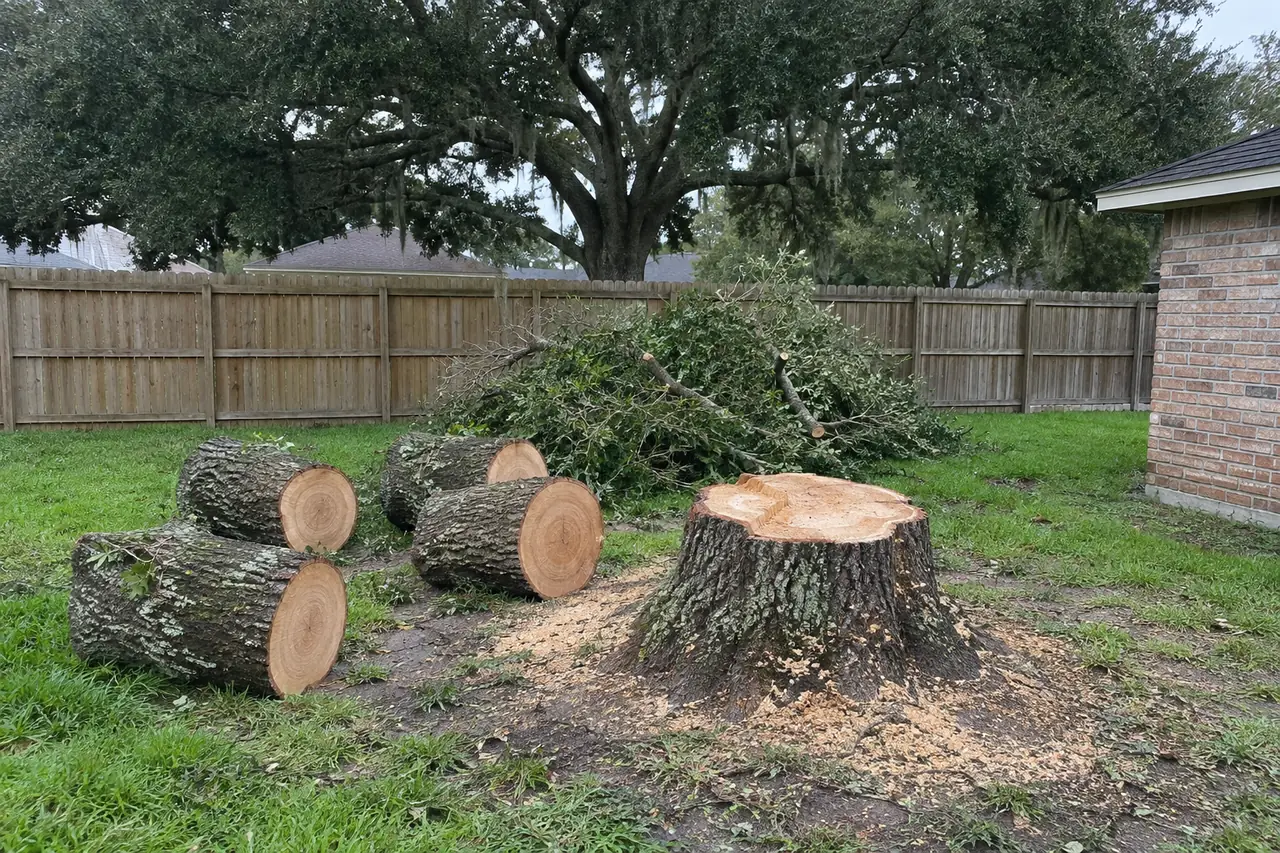
In Angleton, heavy trash goes out with Waste Connections on a zone schedule: Zone 1 in the first and third weeks of the month, Zone 2 in the second and fourth, set out on Monday (city alert, checked Nov 14, 2026; questions to 979-864-4600). The city's size limits for brush piles, and whether the hauler takes wood a hired crew cut, weren't on any page this site could find. Ask before a whole oak goes to the curb, and put the answer in the job agreement. The debris page has Clute's and the county's rules, and burning limits.
What a removal costs around Houston
HomeGuide lists $375 to $2,500 per tree in Houston, and Angi lists $500 to $900 for Houston and $300 to $850 for Texas in its 2025 data (both checked Nov 14, 2026). Height drives most of the spread:
| Tree height | Range |
|---|---|
| Under 30 ft | $150 to $500 |
| 30 to 60 ft | $300 to $1,000 |
| 60 to 80 ft | $650 to $2,000 |
| Over 80 ft | $1,200 to $2,700 |
HomeGuide adds "$500 to $2,500 per day extra" when a crane is needed and "$75 to $250 per dump trip" for debris (checked Nov 14, 2026). These are national guide figures, not Angleton prices. The cost page has the rest, and the contractor's written price is what you'd actually pay.
If a storm put the tree on the house
Take photos before anything is cut, and keep every receipt. The Texas Department of Insurance's guide for TWIA policyholders lists removing "Trees that caused damage to structure" as a temporary repair to document (checked Nov 14, 2026). The hurricane damage page walks through claims, and the request form sends your job to one independent contractor in the Angleton area.
Sources: CenterPoint service centers, Angleton LDC Sec. 23-60, Angleton plat application, Angleton fee schedule, Angleton development permit form, Angleton Waste Connections alert, Lake Jackson Ch. 90, Art. IV, Lake Jackson permit form, Alvin Ch. 15, Art. IX, Texas Local Government Code Ch. 212, Health and Safety Code §752.004 and §752.003, TNMP tree trimming, TNMP debris, CenterPoint tree fact sheet, AgriLife hypoxylon fact sheet, HomeGuide, Angi, TDI TWIA guide. All checked Nov 14, 2026.