
At a glance
- HomeGuide: $2 to $6 per inch on average, with minimum visits of $80 to $160 (checked Nov 14, 2026).
- Deep grinding can count as excavation, which means an 811 call two full business days (48 hours, weekends and legal holidays excluded) before work starts.
- The rule applies on private property too, including your own backyard.
- Grinding takes the stump down; it doesn't take the roots out.
When does grinding a stump count as digging under Texas law?
Texas defines "excavate" broadly. Utilities Code §251.002(5) covers using a motor, engine, hydraulic or pneumatically powered tool, or other mechanized equipment, for work such as "auguring, backfilling, boring, ... digging, ditching, drilling, ... grading, ... ripping, scraping, trenching, and tunneling to remove or otherwise disturb soil" "to a depth of 16 or more inches" (checked Nov 14, 2026).
The definition doesn't mention stumps or trees by name. A stump grinder is powered equipment, though, and deep stump and root grinding can reach 16 inches. That's the point where the 811 rule applies.
Under §251.151, a person who intends to excavate must notify the one-call center "not earlier than the 14th day before the date the excavation is to begin" or "later than the 48th hour before the time the excavation is to begin," "excluding Saturdays, Sundays, and legal holidays." The Railroad Commission of Texas puts it plainly in its brochure: Texas law requires a call to 811 (or 1-800-545-6005) "at least 48 hours before you dig," and a locate must be requested "Even if the excavation is going to be done on private property" (both checked Nov 14, 2026).
- Routine locate tickets "expire in 14 working days," so a ticket called in too early may run out before a busy crew arrives.
- Homeowners can request a locate through Texas811's "online Homeowner Portal."
- Agree ahead of time who makes the call, you or the contractor, and keep the ticket number.
What do the colored flags in the lawn mean?
Once the ticket is in, the utilities mark their lines with paint or flags. The Railroad Commission's brochure lists the colors (checked Nov 14, 2026):
| Color | What runs underneath |
|---|---|
| Red | Electric power lines, cables, conduit and lighting cables |
| Yellow | Gas and oil |
| Orange | Communications |
| Blue | Potable water |
| Green | Sewers and drain lines |
If you've buried lines of your own, such as a sprinkler line or a cable to a shed, point them out to the crew before the grinder starts.
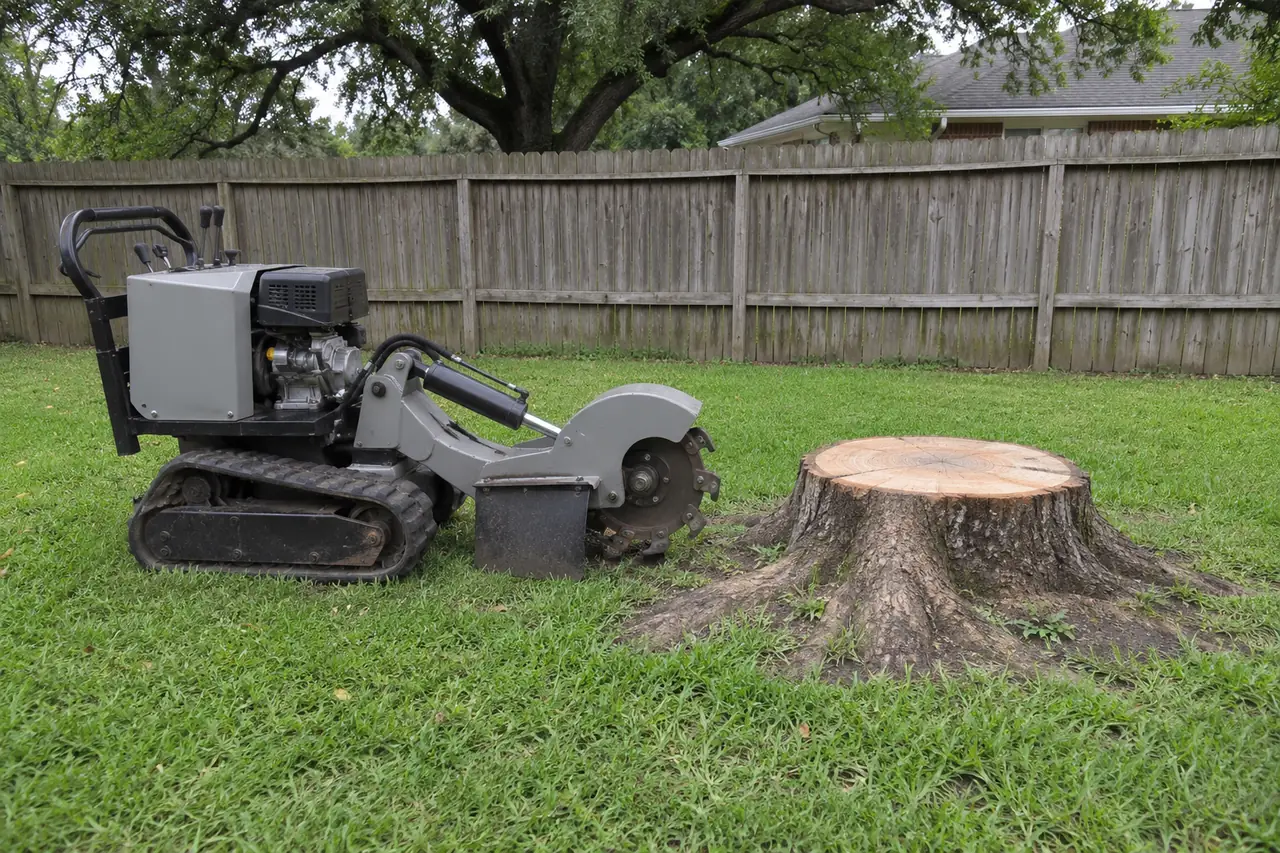
What does the yard look like once the grinder leaves?
Expect a patch of ground chips mixed with soil where the stump stood. HomeGuide is clear that "Stump grinding does not include root removal" (checked Nov 14, 2026), so the roots stay underground.
A few things are worth settling before the grinder starts:
- The chips. Are they raked into the hole, spread, or hauled off? Hauling may be its own line on the bill.
- The depth. If you plan to plant, lay sod or set a fence post nearby, say so, since that decides how deep the grinding goes, and deeper grinding is what brings the 811 rule into play.
- Surface roots. Ask whether roots that run along the top of the lawn are ground too, or left.
- Soft ground. If your yard holds water after rain, ask how the crew plans to get the grinder to the stump and back out.
Brazoria County's 2018 hazard mitigation plan notes that expansive-soil problems "typically occur during drought periods" (checked Nov 14, 2026). If the stump sits close to a slab or a driveway, mention it in your request.
How is a stump priced by the inch?
Most stump prices start from the stump's diameter. HomeGuide's table (checked Nov 14, 2026):
| Stump diameter | Range |
|---|---|
| 12 in. or less | $30 to $70 |
| 24 in. | $50 to $150 |
| 36 in. | $70 to $220 |
| 48 in. | $100 to $290 |
Worked through: a 24-inch stump at HomeGuide's $2 to $6 per inch comes to $48 to $144, in line with the table. But HomeGuide also lists minimum charges of $80 to $160 a visit (checked Nov 14, 2026), so a single small stump costs the minimum, not the per-inch figure. Several stumps on one visit spread that minimum out: HomeGuide's first-stump price is $120 to $400, and each additional stump on the same visit adds $30 to $60.
Angi puts stump removal at "$100 to $150 for the first stump," and about $50 for each one after that (checked Nov 14, 2026). The cost page has the removal side.
Grinding on a lot that's being built on
On an existing home, no Angleton rule this site found treats stump grinding as something that needs city paperwork. New development is different: Angleton's plat application asks for a heritage tree survey and a tree preservation plan, and the city's development permit form lists land-disturbing work that moves more than 10 cubic yards of earth (Sec. 23-93B; checked Nov 14, 2026). If stumps are coming out as part of clearing a lot, check with the city first. The tree rules page has the details.
To get a stump looked at, send a request or call (979) 612-4008. The request is sent to one independent contractor serving Angleton and the rest of Brazoria County. For a tree that hasn't come down yet, read the tree removal page first.
Sources: Texas Utilities Code §251.002, §251.151, Railroad Commission of Texas excavator brochure, Texas811, HomeGuide stump grinding, Angi, Brazoria County Hazard Mitigation Plan (2018), Angleton plat application, Angleton development permit form. All checked Nov 14, 2026.